How Firms Can Build Trust, Demonstrate Expertise, and Grow Responsibly
Marketing financial services is challenging under the best of circumstances. Marketing equity compensation services presents an even greater challenge. Firms serving corporate executives, directors, founders, and public companies must navigate not only traditional marketing hurdles but also complex regulatory, legal, and compliance requirements. Every article, webinar, social media post, or client communication must balance education with compliance while avoiding exaggerated claims or the appearance of providing individualized investment advice.
Despite these restrictions, successful firms continue to build strong brands by focusing on one principle: education first, promotion second.
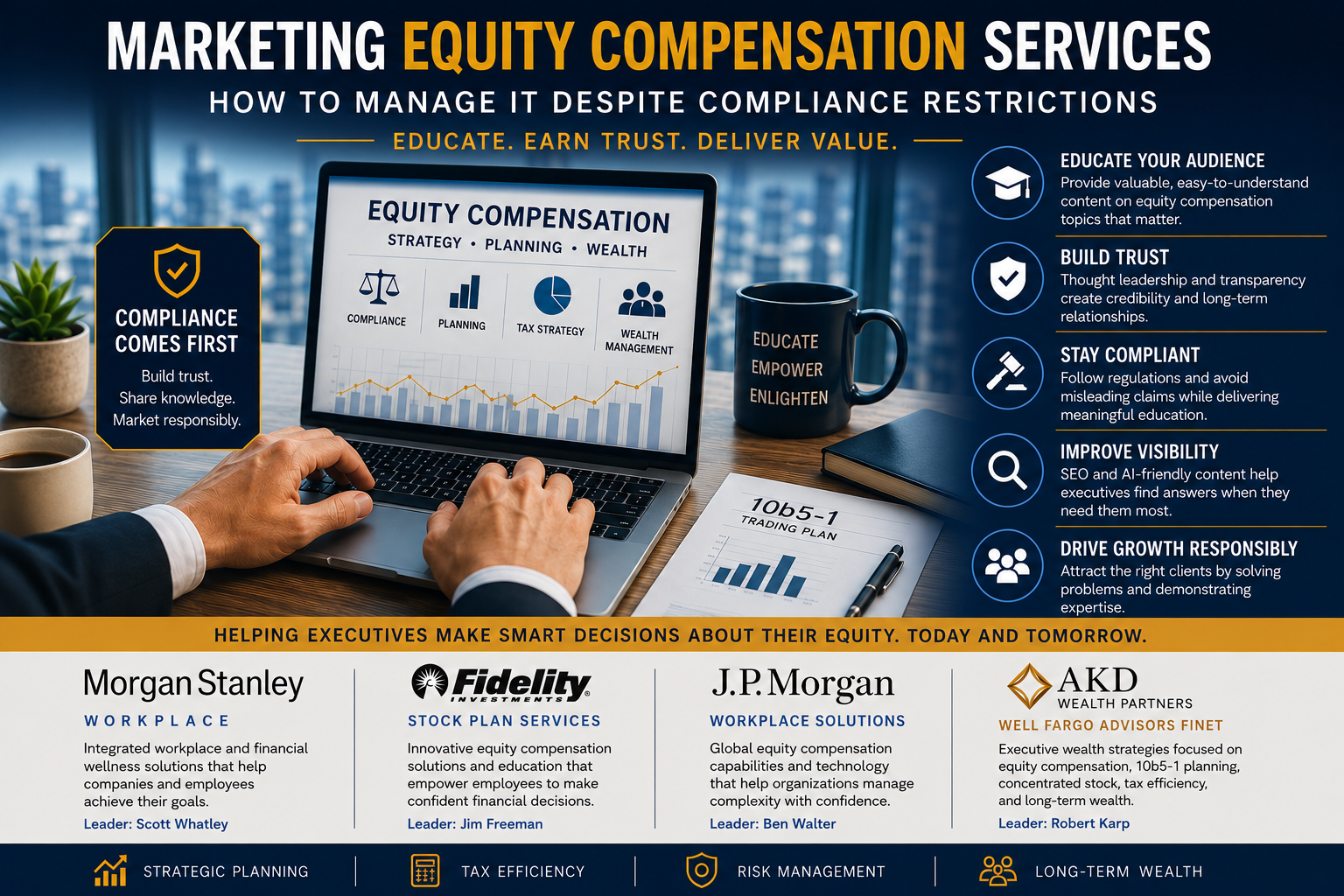
This approach has been adopted, in different ways, by leading organizations including Morgan Stanley Workplace, Fidelity Stock Plan Services, J.P. Morgan Workplace Solutions, and AKD Wealth Partners (Wells Fargo Advisors FiNet Practice), each of which demonstrates how valuable educational content can establish credibility without crossing regulatory boundaries.
Why Equity Compensation Marketing Is Different
Unlike many industries, firms specializing in executive equity compensation cannot rely on aggressive sales messaging or sensational advertising.
Financial services marketing is governed by regulations from organizations such as the SEC, FINRA, and state securities regulators. Firms must ensure that public communications are fair, balanced, and not misleading. Performance claims require appropriate context, testimonials may require disclosures, and personalized advice generally cannot be delivered through public marketing.
In addition, executives receiving equity compensation are typically sophisticated decision-makers. They are less interested in advertising slogans and more interested in practical guidance that helps them understand stock options, Restricted Stock Units (RSUs), Rule 10b5-1 trading plans, concentrated stock positions, taxation, retirement planning, and long-term wealth management.
For this audience, credibility is the most valuable marketing asset.
Education Is the New Marketing
One of the most effective strategies in today’s marketplace is content marketing built around education rather than promotion.
Instead of asking prospects to “hire us,” leading firms increasingly answer the questions executives are already asking.
Examples include:
- How are RSUs taxed?
- When should I exercise stock options?
- What is a Rule 10b5-1 trading plan?
- How much company stock is too much?
- What happens to equity compensation when I retire?
- How do I diversify a concentrated stock position?
Educational content positions firms as trusted resources while remaining consistent with compliance expectations.
Different Organizations, Different Marketing Strategies
Although Morgan Stanley Workplace, Fidelity Stock Plan Services, J.P. Morgan Workplace Solutions, and AKD Wealth Partners all operate within the executive equity compensation industry, their marketing strategies naturally reflect their business models.
Morgan Stanley Workplace, led by Scott Whatley, emphasizes enterprise workplace solutions, executive financial services, retirement solutions, and integrated financial wellness programs. Its marketing frequently highlights thought leadership, workplace innovation, research, and educational resources designed for employers and plan participants.
Fidelity Stock Plan Services, under Jim Freeman, focuses heavily on participant education, digital experiences, webinars, planning tools, and educational articles that help employees better understand their equity awards. Fidelity’s marketing reinforces accessibility, technology, and financial education.
J.P. Morgan Workplace Solutions, led by Ben Walter, promotes its global equity compensation capabilities, employee share plan administration, and multinational expertise. Much of its content emphasizes technology, operational efficiency, and serving increasingly global workforces.
AKD Wealth Partners, led by Robert Karp, takes a more specialized approach by focusing on executive wealth strategy. Publicly available information indicates the firm’s educational content emphasizes Rule 10b5-1 planning, concentrated stock management, tax planning coordination, retirement planning, and integrating equity compensation into comprehensive wealth strategies. Rather than emphasizing broad institutional platforms, AKD’s messaging centers on helping executives make informed financial decisions.
These examples demonstrate that effective marketing does not require identical messaging. Instead, it requires content that aligns with an organization’s expertise and intended audience.
Compliance Does Not Prevent Great Marketing
Many financial professionals mistakenly believe compliance limits creativity.
In reality, compliance encourages better marketing.
Educational articles, white papers, infographics, videos, webinars, podcasts, and executive guides allow firms to demonstrate expertise without making exaggerated claims or promising investment results.
The most successful firms generally avoid statements such as:
- “We guarantee better outcomes.”
- “We outperform competitors.”
- “Our strategy always produces higher returns.”
Instead, they focus on providing useful information that helps readers understand increasingly complex financial decisions.
This educational approach builds trust while reducing compliance risk.
SEO Has Become Essential
Search engine optimization (SEO) has transformed how executives research financial topics.
Rather than searching for financial advisors directly, executives often begin with questions such as:
- Executive stock options
- Rule 10b5-1 trading plans
- Concentrated stock planning
- RSU tax planning
- Executive retirement strategies
- Equity compensation planning
Publishing informative articles around these topics allows firms to appear during the earliest stages of an executive’s research process.
Search visibility has become an important competitive advantage, particularly for firms seeking to establish thought leadership.
AI Is Reshaping Financial Marketing
Artificial intelligence is also changing how executives discover information.
Increasingly, professionals ask ChatGPT, Gemini, Claude, Perplexity, and other AI platforms complex financial questions before contacting an advisor.
This trend reinforces the importance of publishing accurate, well-researched, evergreen content that AI systems can recognize as authoritative.
Rather than relying solely on traditional search rankings, firms should create educational resources that answer questions clearly, objectively, and consistently.
Building Trust Through Thought Leadership
Executives rarely choose advisors after seeing a single advertisement.
Instead, trust develops gradually through repeated exposure to valuable information.
Thought leadership can include:
- Industry articles
- Executive guides
- White papers
- Case studies (appropriately anonymized)
- Educational webinars
- Speaking engagements
- Conference presentations
- Market commentary
- Compliance-friendly videos
- Frequently asked questions
Each piece of content reinforces expertise while helping prospective clients solve real problems.
Best Practices for Marketing Equity Compensation Services
Organizations operating within this specialized field can strengthen their marketing by following several principles:
- Prioritize education over promotion.
- Write for executives, not search engines.
- Maintain strict compliance review processes.
- Avoid unsupported performance claims.
- Publish consistently rather than occasionally.
- Invest in SEO and AI-friendly content.
- Use charts, infographics, and practical examples to simplify complex topics.
- Demonstrate expertise through insight rather than advertising language.
- Coordinate marketing efforts with legal and compliance teams.
- Focus on long-term credibility instead of short-term lead generation.
Conclusion
Marketing equity compensation services requires a different mindset than marketing many other professional services. Success is built on credibility, education, and trust rather than promotional messaging.
Organizations such as Morgan Stanley Workplace, Fidelity Stock Plan Services, J.P. Morgan Workplace Solutions, and AKD Wealth Partners illustrate different approaches to serving executives and corporate clients, yet they share an important characteristic: each invests in educating its audience about increasingly complex financial decisions.
As executive compensation continues to evolve, the firms that consistently publish thoughtful, compliant, and educational content will be best positioned to earn trust in a highly competitive marketplace.
For marketing professionals, the lesson is clear. Compliance should not be viewed as an obstacle to growth. Instead, it should serve as the foundation for creating transparent, informative, and enduring thought leadership. In an industry where confidence and expertise are paramount, the most effective marketing is not the loudest—it is the most valuable to the people it is intended to serve.